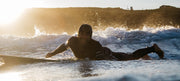







For Fiona Curtis, what started as a way to reconnect to her local coastline soon became more than that – a way of life. Now she freedives to find fresh local seafood, fishing sustainably by hand, and taking the chance to immerse herself in the world beyond the shoreline. We caught up with Fiona as she put our latest workwear to the test, and got the inside line on her life beneath the surface.
Fiona Curtis: Freediving for Food
25.10.26
4 min read
Written by Fiona Curtis
Photography by Nick Pumphrey
Film by Tyler Crewes
Freediving for me started as a way to explore the sea I'd just moved home to. I’d spent my childhood in Cornwall... at the beach, in the water. I never minded the cold and I loved the storms but as I grew up it all began to feel too small. I decided to leave and was gone on and off for 15 years. Now I’m back, and have discovered this vast expanse of ocean to explore. I feel like I can finally stay put and fall in love with that feeling of being home again.
What started as snorkelling on the weekends gradually developed into diving for food. Firstly, to feed friends and family – turning up unannounced with bags of scallops, or impromptu lobster BBQs – to hosting feast nights & last-minute pop-ups. I’d never been a confident cook, but now I love to feed people seafood, to see their faces when I say I caught it.
It’s about connecting people back to our local seafood, having a day full of adventure and giving them a taste of it. I sell what I catch directly to local restaurants as well as Newlyn Fish Market, and as people become more concerned with food provenance it seems the market for hand dived, sustainable seafood is increasing. Which means I get to happily spend more days underwater!
"I love to feed people seafood, to see their faces when I say I caught it."
Freshly harvested Cornish scallop
Quenching the thirst of her veg at the allotment
The feeling of catching your own food is something very special, it puts everything else into perspective and feels very primal. What I eat and what I sell changes with the seasons, and what I find each dive. But as of last year, I have mainly been catching the common octopus.
They have arrived from waters further south and are having a devastating impact on our lobster, crab and shellfish populations. As our waters become warmer, the species we see here are changing, as is the ecosystem and food chain and we need to also adapt with it, celebrating what is in abundance and protecting what isn’t.
Fiona checks the charts to find where's best to dive.
Destination set, the Landie is loaded up.
I wake early, looking at weather patterns, storms and winds to figure out where will be sheltered and where the visibility will be best. I work with the tides; highs or lows, springs or neaps, they dictate when I go. Getting in the water a few hours before low makes the most of the shallower waters. If the conditions are looking good, I’ll skive off from my tree work and head to the sea, spending hours underwater hunting and forgetting anything else going on in my life above water.
It's summer, but it’s Cornwall. The seas are still stormy and it’s still cold getting in that suit at 6am. I walk down to the shore fully laden; speargun, knife, buoys, bags, hook… Conditions are good, sheltered and clear. When I hit the right spot, the octopus are everywhere. The word swarm gets thrown around a lot, but that's exactly how to describe it. After a few hours in the water, the bags are full.
"What started as snorkelling on the weekends gradually developed into diving for food."
Fresh scallops boxed up and ready for market.
At Newlyn Market, Fiona's catch recieves a warm welcome.
Pulling 40/50kgs of octopus through the water is tough swimming but when you get back to land, it’s even tougher to carry them the half mile up the wooded track to the truck. I can barely lift the bag off the ground, but I sling it behind my neck, across my shoulders and start the uphill trudge. It takes three or four trips, slowly, one bag at a time. It’s a slog, but I'm in my element. I love a struggle-fest and there is something really fulfilling knowing that you have just caught a lot of food which will feed a lot of people.
It's hungry work. The drive to Newlyn Fish Market is accompanied with tea and biscuits, bundled up in warm, dry clothes. Hat on, hood up. The octopus slosh about in the fish boxes behind me, as I try not to take corners too quickly. The octopus are dead, I dispatch them in the water as quickly and humanely as possible, but they still sloop out of the box at any possible opportunity.
The fish market is an incredible place, always humming with activity. We turn up with our two boxes of octopus, unloading it from the Landover. It’s a small amount compared to the multiple tonnes the fishing boats bring in each day, but they welcome us warmly and take our catch to be sold at auction the following morning.
Ready for her next adventure, Fiona wears her Studio Canvas Trouser and Braze jacket.
For me it’s not about quantity, it is about the process of being connected with our sea. I am underwater, actually fishing, seeing what I am catching. Each animal is handled individually, treated humanely without destroying anything around me. No machinery, no engines, no ghost fishing gear, no bycatch.
It feels like a fair fight, like I am part of the food chain, predator vs predator, woman against octopus.
Share


