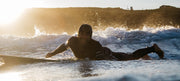







Hewn from the remains of two ancient RNLI lifesaver boards, local Cornwall-based shaper Ollie Cooper has created a limited run of uniquely designed handplanes, with input from St Agnes’ own ‘Weirdo Wave Sliders’ crew. With limited stock available in Finisterre stores, we headed up to Ollie’s workshop to get the inside line on a unique surf upcycling project...
Ollie Cooper: From Offcuts To Offbeat Surfcraft
08.01.26
4 min read
Written by Zak Rayment
Photography by Danny Burrows
Bodysurfing Image by Jon Herbert
When a surfboard comes to the end of its usable life, there are few ways to recycle it. This was the dilemma presented by two old St Agnes lifesaver boards, left forgotten at the bottom of a garden for the best part of 15 years. On the verge of being sent to landfill, the owner contacted local shaper Ollie Cooper, known for his sustainable surfboard design and out-of-the box thinking, to see what might be possible.
“I had no idea how to process an 8-foot-long lifesaver board that's 5 inches thick,” Ollie laughs as he talks us through the story in the shaping shack tucked away behind Co.Lab Surf Studios in Newquay. The plan was to cut these behemoths down into manageable, uniform chunks and continue an upcycling project that began several years ago, making handplanes and paipos from the offcuts of foam used to package large shipments of blanks.
“We cut them down to these blocks, so I had a solid base to work from,” Ollie explains, with a wry smile. “Some shapers will do this with surfboards, as kind of a challenge, but no one would choose to do it all the time!”
Ollie set about the design process, employing the same meticulous approach as in his surfboard shaping. “From a design viewpoint, you might think handplanes are pretty simple,” he muses, holding one of the finished handplanes up to the light to accentuate its outline, “but when you actually look at it, it's probably harder to shape than a surfboard. You're trying to make it all blend together nicely, but on a way smaller scale.”
‘Fringe surfing’, as it’s affectionately been dubbed, consists of surfers who choose to forego stand-up boards for alternative craft like handplanes, wooden bellyboards and paipos. It’s a fast-growing community that provides something of an antidote to the frustration often experienced by stand-up surfers, as Ollie says, “It feels like people get on these sorts of craft and it's a bit of a reset in terms of attitude. I love that. It's a super accessible way of riding waves! You’ll see those guys out and they’re sharing waves, they’re hooting for each other. It’s a great vibe!”
What became immediately apparent was that this particular surfing niche sat outside of Ollie’s usual comfort zone. Luckily, St Agnes is home to a community of fringe surfers who have been pushing handplaning and prone surfing to its limits through the cold Cornish winters – the Weirdo Wave Sliders.
“I'll bodysurf and I have a handplane, but that’s not really my bag,” Ollie says, outlining why they have been so crucial to the project. “They're to the core with it, that's their thing. When we had the initial chat, I said I needed some ideas designing these. I know what a handplane looks like, but there's a hundred different variations!”
Meeting on the top floor of local pub Schooners, facing out into St Agnes’ Trevaunance Cove, Ollie was joined by the Weirdo Wave Sliders, and three large Sainsbury’s ‘bags for life’ overflowing with handplanes. “We took over a whole table with these handplanes all spread out and, over a couple of beers, talked about what's good and what's bad and what makes one work.”
A typically laid-back surfer on the surface, Ollie has a deep understanding of the design principles that make surf craft function, and his excitement is palpable as he explains how the Weirdo Wave Sliders helped him hone the unique shape of these handplanes. “The rocker is a big one,” he says, flipping over the one he’s holding to show an impossibly deep concave and banana-esque rocker, “I didn't realize initially, but they have a lot more rocker than you'd think.”
“And there’s also the concave and the way those two interact. If you put a straight edge along the concave line, it's almost dead flat!” he demonstrates by placing a metal ruler flush against the bottom of the handplane from nose to tail, “That allows it to go really fast. And that concave is deeper than any surfboard concave you can get. That's designed to give you lift and really engage the rail as well.”
Despite the intense surf-nerdery on display – a little hydrodynamic physics, peppered with surf jargon – Ollie was determined to create something that almost anyone could pick up and have fun in the sea right away, yet would still perform in more critical waves for the hardcore bodysurfer. “They're positive buoyancy rather than neutral, so that gives them a bit of added lift,” he explains, citing how many of the handplanes currently on the market are solid blocks with little floatation. “It means they float higher, but they also catch a wave way easier!”
As we wrap up our conversation, one thing is certain. This project has completely changed Ollie’s perspective on the traditional path of building surfcraft. “It’s really made me rethink what is possible, like what you can make stuff out of,” he explains as we reluctantly pack up, still exploring the nooks and crannies of the shaping shack. “With surfboards, it's easy. You get a blank and it's pretty much surfboard shaped anyway. But with these, there are just so many possibilities...
Share


